If you’ve read any type of romance in the last few years, you’ve probably heard of a “Spice Rating.” It’s a relatively new concept that’s gained a lot of traction in recent years as more and more books are including HIGHLY explicit content in everyday romance stories, which has left readers wondering, “How Spicy is THIS Book?’ every time they want to read a new one.
Here, I’ll attempt to explain what each level on the scale means and how we can use them to better identify how to pick our next book. This is applicable to any book out there, as “spicy books” are in every sub-genre of romance, from sweet romance Hallmark-style stories to suspense and sci-fi, and everything in between.
If you prefer romances that keep things strictly behind closed doors, check out my Closed Door Sports Romance Recommendations.
What is a Spice Rating?
So what is a spice rating? It’s basically a short-hand handed easy way for readers to identify and label how much spicy content is in a book just at a glance. It’s been made very popular by bloggers and Bookstagram/BookTok creators, and has transitioned into authors using it to market their books as well.
Readers used to be able to clearly identify romance novels, “spicy books”, by the cover; you know which ones I’m talking about, those books with the shirtless guys on the covers. However, the current trend of illustrated covers has challenged that ease of detection.
Enter the Spice Rating. It helps readers, like you and me, find books with a sexual content level they are comfortable with; it has different “spice levels.” The problem is that the Spice Rating is not standardized. So each author, reader, and publisher has a different definition of their take on a Spice Rating, though they do all follow a generalized rating scale.
People use a mix of things to describe the rating system: emojis (🌶️, 🔥, ❤️), stars, or short labels like “sweet,” “closed door,” or “open door” are often used. But again, you still have to know how each person rates their books to know what the heck their rating scale is. But they all follow a pretty similar definition, which I’ll explain next.
Check out the Mystery Review Crew’s use of a Spicy Rating scale as it applies to the mystery genre or how Owl Crate uses a Spice Rating scale in their book marketing.
Understanding the Spice Rating Scale: From Sweet to Spicy
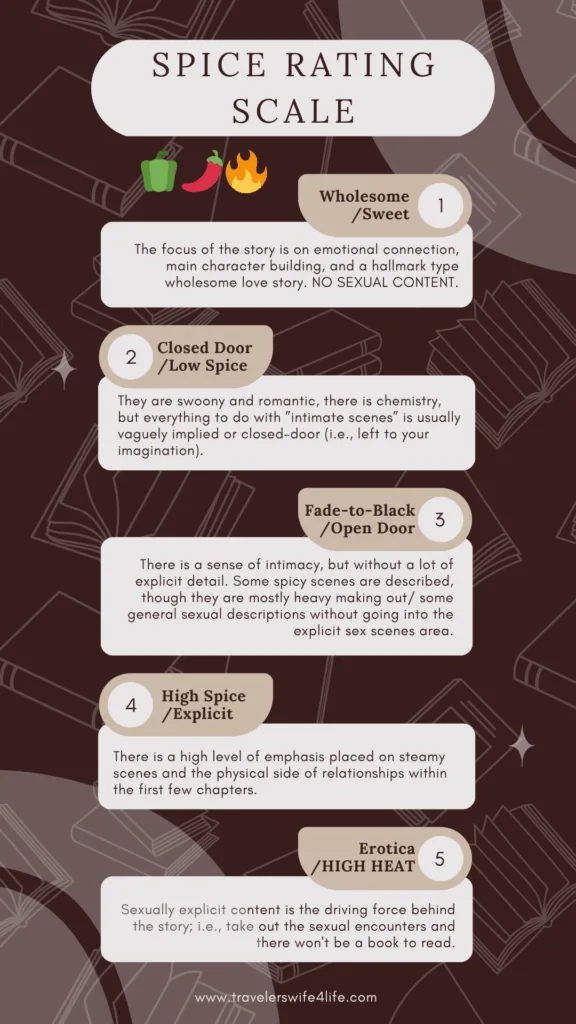
Sweet Romance/Wholesome romance (NO SPICE) Emojis used: Usually a green pepper 🫑, or a heart❤️.
Three common factors:
- The focus of the story is on emotional connection, main character building, and a hallmark type wholesome love story.
- There is no sexual content on the page; often, sweet romances have just one or two chaste kisses that are not descriptive.
- Usually, there is NO language. It’s a book that the whole family could read without blushing.
Two of my favorite authors who are great examples of sweet romance would be Denise Hunter and Toni Shiloh. Both write wonderful character-driven stories that make you feel warm and cozy inside in the romance genre. Denise Hunter has even had a few of her books turned into Hallmark movies :).
Closed Door Romance (or LOW Spice)
Closed-Door (LOW Spice) Emojis used to describe spiciness level: Usually one chilli pepper🌶️, a fire 🔥, or a heart❤️.
Three common Factors:
- The focus of the story remains on the story, but has a high emphasis on the emotional connection between the main characters.
- Flirting will happen, kisses will happen, but the details remain something you could feel comfortable with a teenager reading; i.e., think of authors like Courtney Walsh, Emma St. Clair, or Nicole Van.
- They are swoony and romantic, there is chemistry, but everything to do with ”intimate scenes” is usually vaguely implied or closed door (i.e., left to your imagination).
*A fourth option would be that most closed-door romance does NOT include language; however, this can vary by author. So, I didn’t include it in the three common factors.
Why did I link Courtney Walsh, Emma St. Clair, and Nicole Van here? They are perfect examples of writing a great storyline without crossing into blushing territory. They have great love interests, witty banter, fun flirtations, and stories that stick with you. You can see my book reviews of these authors’ books here on the site.
🔥 Moderate Spice (Open Door, Fade-to-black scenes)
Moderate Spice Emojis used to describe spiciness level: at least two peppers🌶️🌶️, several fires🔥🔥, and occasionally people use hearts❤️❤️.
Three Common factors:
- Usually, there is a sense of intimacy, but without a lot of explicit detail. Some spicy scenes are described, though they are mostly heavy making out/ some general sexual descriptions without going into the explicit sex scenes area.
- Emotional development/ story development is usually still the forefront of the story plot.
- There is usually language in these stories.
An author in this category would be Mariana Zapata (known as the QUEEN of slow burn romance in my opinion). She has a way of really balancing character development with love stories; she only has one “open door” scene in each of her books at the very end.
The sensuality level’s here can really vary depending on whether the author considers themselves to write “open door” or “fade-to-black”. This is often the hardest level for me to define, as most books that fall into this category still have a great deal of emotional depth, often with a very few “steamy romance” scenes, and the emotional impact of these stories can be profound.
🌶️ High Spice (Steamy/Explicit)
High Spice Emojis used to describe spiciness level: usually includes multiple chili peppers🌶️🌶️🌶️🌶️, multiple fires🔥🔥🔥🔥, and sometimes people use hearts❤️❤️❤️❤️.
Three Common Factors:
- There is a high level of emphasis placed on steamy scenes and the physical side of relationships within the first few chapters.
- Sexual tension and sexual scenes are often the backbone of the storyline.
- Most of the story will revolve around sexual encounters.
Examples of authors who write this high-spice contemporary romance content would be authors like Tessa Bailey, Ana Huang, and Hannah Grace. High spice fantasy authors would be Sarah J Maas (Court of Thorns and Roses series) or Rebecca Yarros (The Empyrean Series).
These books are always defined as “Open door” and Spicy Romance books.
🔥🔥🔥 Extra Hot (Erotic romance /High Heat) Spice Rating
Extra hot/ Erotica Emojis used to describe spiciness level:🌶️🌶️🌶️🌶️🌶️, 🔥🔥🔥🔥🔥, ❤️❤️❤️❤️❤️.
Three Common Factors:
- Stories have frequent, highly descriptive sexual scenes and explicit language.
- Often, the stories explore sexual kinks, dark elements/themes, or have morally questionable content (think no consent, polygamy, or incest).
- Sexually explicit content is the driving force behind the story; i.e., take out the sexual encounters and there won’t be a book to read.
Popular authors in this Extra Hot (otherwise known as Erotica) category would be Elle Kennedy, Elsie Silver, Penelope Douglas, and Katee Robert.
These high-heat romance books are on the rise with romance readers in the romance literature market. As you walk down the romance aisle next time you are in the bookstore, most “romance” books will likely fall into this category.
Why Readers Prefer Different Spice Rating Levels
So why are different spicy levels a thing? Why are they trending upwards and being used in marketing everywhere? Everyone has a different comfort level when reading and talking about intimacy. Some readers just want the emotional build-up and the sweet chemistry of first love (sweet or closed door), others love the tension and realism of open door romances.
Romance is, after all, about connection, communication, and finding love in the everyday. So it should come as no surprise that the romance genre is booming with people truly searching for that look into what that special spark looks like, or as a reminder of when they found their special someone.
Introducing the Traveler’s Wife 4 Life Spice Rating Scale
Now you may ask, well, how does Kimmie (the traveler’s wife 4 life) use this spice rating scale? To answer that, I’ll say that I actually don’t often use it in my reviews, though I’m starting to. As I’ve said previously, it is hard for me to sometimes gauge just where a book should fall into these categories. That’s why I wrote this article to give myself more of a baseline to go off, and in turn, hopefully help other readers figure out how to give their reviews a spice rating too.
As always, if you see something I can improve on or something you think I should revise or change about this spice rating scale, let me know.
Sincerely,
Kimmie
Frequently asked questions regarding Romance Spice levels:
- What does closed-door romance mean?
→ Intimate scenes are implied or fade-to-black, never described in detail. - Is closed door the same as clean romance?
→ Not always. Clean may exclude language/alcohol/etc., while closed door focuses on intimacy that is fade-to-black. - What is fade-to-black in romance?
→ Scene ends before physical details are described. - What is considered spicy romance?
→ Books that include explicit, on-page sexual intimacy between characters.